DIFBND
| (Material data) | |
|---|---|
| Update History: (New keyword in v11) | Last updated on : 23-07-2013 |
DIFBND Material, FuncType(=0), DiffTime
or
(For diffusion bonding time as a function of temperature & pressure)
DIFBND Material, FuncType, NTemp, NPres
Temp(1), …, Temp(NTemp)
Press(1), …, Press(NPres)
- DiffTime(1, 1), …, DiffTime (NTemp, 1)
-
:
DiffTime (1, NPres), …, DiffTime (NTemp, NPres)
| OPERAND | DESCRIPTION | DEFAULT |
|---|---|---|
| Material | Material Number | None |
| FuncType | Diffusion bonding data type = 0 Constant =7 Function of temperature and pressure | 0 |
| DiffTime | Diffusion bonding time value | 0 |
| NTemp | Number of temperature data | |
| NPres | Number of pressure data | |
| Temp(i) | Temperature of ith data | |
| Pres(i) | Pressure of ith data | |
| DiffTime(i,j) | Diffusion bonding time of ith and jth data |
DEFINITION
DIFBND specifies the required time to achieve 100% bonding under certain conditions (temperature, pressure).
REMARKS
The time to achieve complete bonding is a strong function of temperature and pressure. 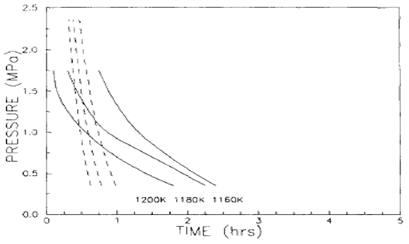 Example of experimental and predicted diffusion bonding times (—- Experimental, - - - theoretical)
 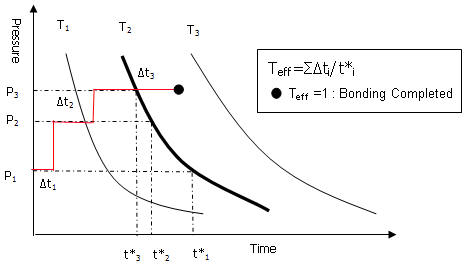 Time vs Pressure Plot Temperature and pressure are location and time dependent in real process. Thus, simulation uses an effective bonding completion. Applicable object types: Elastoplastic Applicable simulation type: Superplastic forming