Appendix IV: Determining ‘R’ Coefficients for anisotropy models
DEFORM® material model allows for anisotropy in sheet metal. Two of the models use “R” ratios for defining anisotropic behavior in rolled sheet.
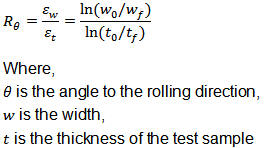
The R value represents a ratio between orthogonal components of transverse strain in a tension test.
Tension test samples are typically cut at 0°, 45°, and 90° to the rolling direction of the sheet. One can then define
 as,
as,
 | (EQ.1)
—|—
The measurements are typically taken at an elongation of 15 to 20%, or before the onset of necking on low ductility materials.
In DEFORM, the user may specify  ,
,  and
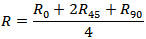
and  or a single valued
  may be specified, where is defined as,
 | (EQ.2)
—|—
Quadratic Hill Criterion (From Wikipedia):
The quadratic Hill yield criterion [1]. has the form
 | (EQ.3)
—|—
The quadratic Hill yield criterion depends only on the deviatoric/shear stresses and is pressure independent.
It predicts the same yield stress in tension and in compression.
[edit] Expressions for F, G, H, L, M, N:
If the axes of material anisotropy are assumed to be orthogonal, we can write,
 | (EQ.4)
—|—
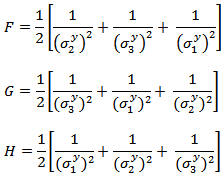
Therefore we have,
 | (EQ.5)
—|—
Similarly, if  are the yield stresses in shear (with respect to the axes of anisotropy), we have,
 | (EQ.6)
—|—
R. Hill. (1948). A theory of the yielding and plastic flow of anisotropic metals. Proc. Roy. Soc. London, 193:281–297.
Related Topics: