NDISFM
| (Material Data) |
|---|
| Last updated on : 18-08-2014 |
NDISFM Material, Ftype(=0), NumDis
or
NDISFM Material, Ftype(=1,2), Ndata
Temp/Strate(1), NumDis(1)
::
Temp/Strate(Ndata), NumDis(Ndata)
or
NDISFM Material, Ftype(=3), N1, N2
Temp(1) .. Temp(N1)
Strate(1) .. Strate(N2)
NumDis(1,1)
::
NumDis(N1, N2)
| OPERAND | DESCRIPTION | DEFAULT |
|---|---|---|
| Material | Material number | None |
| Ftype | Function type 0 = Constant value 1 = f(temperature) 2 = f(strain-rate) 3 = f(temperature, strain-rate) | None |
| NumDis | Constant Number of dislocation families value | 0.0 |
| N1 | Number of data pairs for the function | None |
| N2 | Number of data pairs for the function | None |
| Temp | Temperature of (i)th data pair | None |
| Strate | Strain-rate of (i)th data pair | None |
| Alpha(i) | Number of dislocation families at (i)th data pair | None |
| Alpha(i,j) | Number of dislocation families at (i,j)th data pair | None |
DEFINITION
NDISFM defines the “no. of dislocations” which specifies the number of “dislocation families” [1]
REMARKS
The differential in dislocation density (increase or decrease) is given by, | 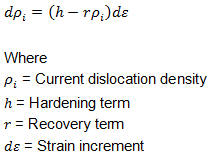 |
|
—|—
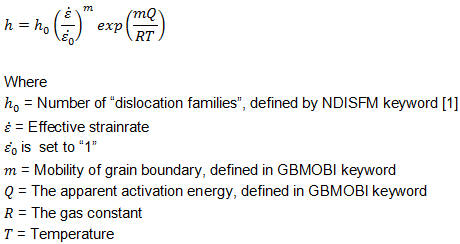
The hardening term is given in
 |
|
—|—
[1] “A model of continuous dynamic recrystallization”; S. Gourdet, F. Montheillet. Acta Materialia 51 (2003) 2685–2699.
Applicable object types: Elasto plastic