FSTRES
| (Material data) | |
|---|---|
| Update History: V11 – Types 13, 14, 15, and 16 have been added. V11.1 – Type 17 has been added. | Last updated on : 25-04-2016 |
Flow stress data can be defined as one of the 17 types, or as a user subroutine.
| Date | Flow stress model | Type No |
|---|---|---|
CMNY type 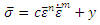 |
1 | |
Table data  : log interpolation : log interpolation |
2 | |
| Table data : linear interpolation |
3 | |
Temp. & Strain-rate dependent I  |
4 | |
Temp. & Strain-rate dependent II  |
5 | |
Y-H type  |
6 | |
Table data  : log interpolation : log interpolation |
7 | |
| Table data : linear interpolation |
8 | |
Generalized Johnson & Cook  |
9 | |
Zerilli-Armstrong  |
10 | |
| New in v11 | Norton-Hoff 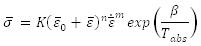 |
11 |
| 3Dv6.1 2Dv9.2 | Microstructure 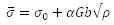 |
12 |
| New in v11 | General table data: Log interpolation | 13 |
| New in v11 | Bird-Mukherjee-Dorn Equation 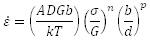 |
14 |
| New in v11 | General table data: Linear interpolation | 15 |
| New in v11 | Table data (under development)  |
16 |
| New in v11.1 | Crystal Plasticity model 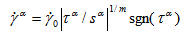 |
17 |
| User specified flow stress routine | N |
Each flow stress type is documented separately below.
NOTE: Type = 16 has not been fully implemented yet in v11.
Type = 17 has not been fully implemented yet in v11.1; currently only available in Material Suite in v11.1
CMNY model (Type = 1)
FSTRES Material, Ftype
c, n, m, y
| OPERAND | DESCRIPTION | DEFAULT |
|---|---|---|
| Material | Material number | None |
| Ftype | Function type = 1 c material constant n strain sensitivity index m strain rate sensitivity index y material constant |
None |
DEFINITION
FSTRES specifies the flow stress for a particular material.
REMARKS
Flow stress data can be entered as one of 5 flow stress function types, or as a user subroutine. The FSTRES function for Ftype =1 is: | 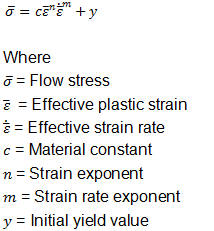 |
|
—|—
Applicable simulation types: Isothermal Deformation
Non-Isothermal Deformation
EXAMPLE
If the flow stress of material 3 could be expressed as:
 |
|
—|—
The FSTRES keyword representation would be,
FSTRES 3, 1
103.8, 0.22, 0, 0
Table data (Type=2) : log interpolation
Table data (Type=3) : linear interpolation
FSTRES Material, Ftype
Nstrain, Nsrate, Ntemp
Strain(1)
:
Strain(Nstrain)
Srate(1)
:
Srate(Nsrate)
Temp(1)
:
Temp(Ntemp)
Stress(i,j,k)
:
Stress(Nstrain, Nsrate, Ntemp)
| OPERAND | DESCRIPTION | DEFAULT |
|---|---|---|
| Material | Material number | None |
| Ftype | Function type = 2 linear interpolation of data using  = 3 linear interpolation of data using = 3 linear interpolation of data using |
|
 |
None | |
| Nstrain | Number of strain sampling points | None |
| Nsrate | Number of strain rate sampling points | None |
| Ntemp | Number of temperature sampling points | None |
| Strain(i) | Strain at ith sampling point | None |
| Srate(j) | Strain rate at jth sampling point | None |
| Temp(k) | Temperature at kth sampling point | None |
| Stress(i, j, k) | Flow stress at ith, jth, kth sampling point (((Stress(i, j, k), i = 1, Nstrain), j = 1, Nsrate), k = 1, Ntemp) | None |
REMARKS
Flow stress data that is in the form of sampled points can be entered with Ftype =2 or Ftype = 3. The data should contain strain, strain rate, and temperature data for each sampling point. | 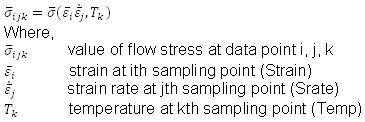 |
|
—|—
If Ftype = 2, the flow stress is linearly interpolated and extrapolated using
|
—|—
If Ftype = 3 the flow stress is linearly interpolated and extrapolated using
|
—|—
Applicable simulation types: Isothermal Deformation, Non-Isothermal Deformation
EXAMPLES
Suppose the flow stress of material 3 had been measured at the strains, strain rates, and temperatures listed in Tables A.1 and A.2. The FSTRES keyword representation for ln-ln interpolation would be FSTRES 3, 2 3, 4, 2 0.05, 0.30, 0.60 0.10, 1.0, 5.0, 10.0 1800.0, 2000.0 8.3355, 9.9711, 10.6868 14.8227, 17.7313, 19.004 22.1651, 26.5146, 28.4176 26.3589, 31.5313, 33.7944 6.2516, 7.4783 8.0151 11.117, 13.2985, 14.253 16.6238, 19.886, 21.3132 19.7692, 23.6485, 25.3458 Table A.1 Flow stress of material 3 at T = 1800° F | Strain  | 0.05 | 0.30 | 0.60
—|—|—|—
Strain rate
0.10 | 8.34 | 9.97 | 10.67
1.00 | 14.83 | 17.73 | 19.00
Table A.2 Flow stress of material 3 at T = 2000° F
Strain | 0.05 | 0.3 | 0.6
—|—|—|—
Strain Rate
0.10 | 6.25 | 7.48 | 8.02
1.00 | 11.12 | 13.30 | 14.25
5.00 | 16.62 | 19.89 | 21.31
10.00 | 19.77 | 23.65 | 25.35
Temp. & Strain-rate dependent I (Type=4)
FSTRES Material, Ftype
α, ΔH, A, n, R
| OPERAND | DESCRIPTION | DEFAULT |
|---|---|---|
| Material | Material number | None |
| Ftype | Function type = 4 |
None |
| α | Material constant | None |
| ΔH | Activation energy | None |
| A | Material constant | None |
| n | Strain rate sensitivity index | None |
| R | Gas constant 8.3144E+03 (N-mm/g-mole/K) Or 1.986 (Btu/lbf-mole/R) |
REMARKS
The FSTRES function for Ftype =4 is | 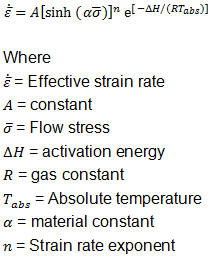 |
|
—|—
This flow stress function is used primarily for aluminum alloys.
Temp. & Strain-rate dependent II (Type=5)
FSTRES Material, Ftype
Δ H, A, n, R
| OPERAND | DESCRIPTION | DEFAULT |
|---|---|---|
| Material | Material number | None |
| Ftype | Function type = 5 |
None |
| ΔH | Activation energy | None |
| A | Material constant | None |
| n | Strain rate sensitivity index | None |
| R | Gas constant 8.3144E+03 (N*mm/g-mole/K) or 1.986 (Btu/lbf-mole/R) |
REMARKS
The FSTRES function for Ftype =5 is, | 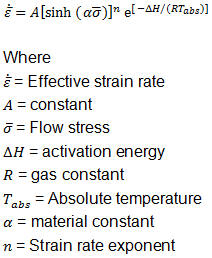 |
|
—|—
This flow stress function is used primarily for aluminum alloys.
Y-H type (Type=6)
FSTRES Material, Ftype(=6), Y_Ftype (=0), H_Ftype(=0)
Y_ConstValue
H_ConstValue
or
FSTRES Material, Ftype(=6), Y_Ftype (=1), H_Ftype(=2)
Ndata
Temp(1), Y_Value(1)
::
Temp(Ndata), Y_Value(Ndata)
Ndata
Atom(1), H_Value (1)
::
Atom(Ndata), H_Value(Ndata)
or
FSTRES Material, Ftype(=6), Y_Ftype (=3), H_Ftype(=3)
NTemp, NAtom
Temp(1), …, Temp(NTemp)
Atom(1), …, Atom(NAtom)
- Y_Value(1, 1), …, Y_Value(NTemp, 1)
-
:
Y_Value(1, NAtom), …, Y_Value(NTemp, NAtom)
NTemp, NAtom
Temp(1), …, Temp(NTemp)
Atom(1), …, Atom(NAtom)
- H_Value(1, 1), …, H_Value(NTemp, 1)
-
:
H_Value(1, NAtom), …, H_Value(NTemp, NAtom)
| OPERAND | DESCRIPTION | DEFAULT |
|---|---|---|
| Material | Material number | None |
| Ftype | Function type = 6 |
None |
| Y_Ftype | Function type: 0 = Constant Y-value 1 = Temperature dependent Y-value 2 = Atom dependent Y-value 3 = Temperature and Atom dependent Y-value | None |
| H_Ftype | Function type: 0 = Constant H-value 1 = Temperature dependent H-value 2 = Atom dependent H-value 3 = Temperature and Atom dependent H-value | None |
| Y_ConstValue | Constant value for Y | 0.0 |
| H_ConstValue | Constant value for H | 0.0 |
| Ndata | Number of data | 0 |
| NTemp | Number of temperature data | 0 |
| NAtom | Number of atom data | 0 |
| Temp(i) | Temperature of ith data | 0 |
| Atom(i) | Atom of ith data | 0.0 |
| Y_Value(i,j) | Y_Value function data | 0.0 |
| H_Value(i,j) | H_Value function data | 0.0 |
REMARKS
In above equations for FSTRES function Ftype =6 | 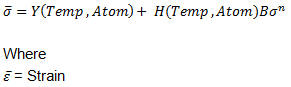 |
|
—|—
This flow stress function is used primarily for heat treatment simulations.
Table data (Type=7) : log interpolation
Table data (Type=8) : linear interpolation
FSTRES Material, Ftype
Nstrain, Natom, Ntemp
Strain(1)
:
Strain(Nstrain)
Satom(1)
:
Satom(Nsrate)
Temp(1)
:
Temp(Ntemp)
Stress(i,j,k)
:
Stress(Nstrain, Nsrate, Ntemp)
| OPERAND | DESCRIPTION | DEFAULT |
|---|---|---|
| Material | Material number | None |
| Ftype | Function type = 7 log interpolation of strain = 8 linear interpolation of strain | None |
| Nstrain | Number of strain sampling points | None |
| Natom | Number of atom sampling points | None |
| Ntemp | Number of temperature sampling points | None |
| Strain(i) | Strain at ith sampling point | None |
| Satom(j) | Strain rate at jth sampling point | None |
| Temp(k) | Temperature at kth sampling point | None |
| Stress(i, j, k) | Flow stress at ith, jth, kth sampling point (((Stress(i, j, k), i = 1, Nstrain), j = 1, Nsatom), k = 1, Ntemp) | None |
Generalized Johnson & Cook (Type=9)
FSTRES Material, Ftype
A,B,X,Δ0, E, n, m,
Alpha, Beta, Eps0, Troom, Tmelt, Tb, k
| OPERAND | DESCRIPTION | DEFAULT |
|---|---|---|
| Material | Material number | None |
| Ftype | Flow stress type = 9 (Generalized Johnson & Cook, usually for machining) | None |
| A | Material parameter | 0 |
| B | Material parameter | 0 |
| X | Material parameter | 0 |
| Δ0 | Material parameter | 0 |
| E | Material parameter | 0 |
| N | Material parameter | 0 |
| M | Material parameter | 0 |
| Alpha | Material parameter | 0 |
| Beta | Material parameter | 0 |
| K | Material parameter | 0 |
| Tb | Material parameter | 0 |
| Eps0 | Reference strain rate | 0 |
| Troom | Room temperature | None |
| Tmelt | Melting temperature | None |
REMARKS
In above equations for FSTRES function Ftype =9 | 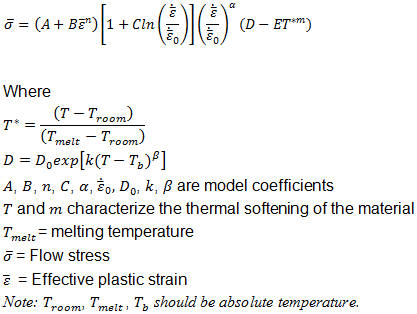 |
|
—|—
This flow stress function is used primarily for machining applications.
Zerilli-Armstrong (Type=10)
FSTRES Material, Ftype
a, c1, c3, c4, c5, n
| OPERAND | DESCRIPTION | DEFAULT |
|---|---|---|
| Material | Material number | None |
| Ftype | Flow stress type = 10 (Zerilli-Armstrong) | None |
| a, c1, c3, c4, c5, n | Material parameters |
REMARKS
In above equations for FSTRES function Ftype = 10: This flow stress function is used primarily for machining applications.
Norton-Hoff (Type=11)
FSTRES Material, Ftype
K0, m, n, eps0, beta
| OPERAND | DESCRIPTION | DEFAULT |
|---|---|---|
| Material | Material number | None |
| Ftype | Flow stress type = 11 (Norton-Hoff) | None |
| K0, m, n, eps0, beta | Material parameters | 0 |
DEFINITION
FSTRES specifies the flow stress for a particular material.
REMARKS
In above equations for FSTRES function Ftype = 11:  : strain rate
  : strain Sij : flow stress component T : temperature
Microstructure (Type=12)
FSTRES Material, Ftype(=12), SFuncType(=0), GFuncType(=0)
ConstValue
or
FSTRES Material, Ftype(=12), SFuncType(=1), GFuncType(=0)
Ndata
Temp(1), IniStress(1)
::
Temp(Ndata), IniStress(Ndata)
or
FSTRES Material, Ftype(=12), SFuncType(=2), GFuncType(=0)
Ndata
Strate(1), IniStress(1)
::
Strate(Ndata), IniStress(Ndata)
or
FSTRES Material, Ftype(=12), SFuncType(=3), GFuncType(=0)
NTemp, NStrate
Temp(1), …, Temp(NTemp)
Strate(1), …, Strate(NStrate)
- IniStress(1, 1), …, IniStress(NTemp, 1)
-
:
IniStress(1, NStrate), …, IniStress(NTemp, NStrate)
| OPERAND | DESCRIPTION | DEFAULT |
|---|---|---|
| Material | Material number | None |
| Ftype | Flow stress type | None |
| SFuncType | Type of initial stress = 0 Constant =1 function of temperature = 2 function of strain-rate = 3 function of temperature and strain-rate | |
| GFuncType(=0) | Type of shear modulus (Not used yet) | |
| NTemp | Number of temperature data | 0 |
| NStrate | Number of strain-rate atom data | 0 |
| Temp(i) | Temperature of ith data | 0 |
| Strate(i) | Strain-rate of ith data | 0.0 |
| IniStress(i,j) | Initial stress( ) |
REMARKS
| 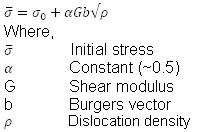 |
|
—|—
General table data: Log interpolation (Type = 13)
General table data: Linear interpolation (Type=15)
FSTRES Material, Ftype(=13,15)
NVars
NdataX1, X1_ID1, X1_ID2
NdataX2, X2_ID1, X2_ID2
X1(1), … ,X1(NdataX1)
X2(1), …, XN(NdataX2)
FS(1,1)
::
FS(NdataX1,1)
FS(1, NdataX2)
::
FS(NdataX1, NdataX2)
Note: Format given here is for 2D array. FS=(X1, X2) is saved in 1D array in DB
| OPERAND | DESCRIPTION | DEFAULT |
|---|---|---|
| Material | Material number | None |
| Ftype | Flow stress type = 13 Linear interpolation = 15 Log interpolation | |
| NVars | Number of independent variables | |
| NdataX1 | Number of data for 1st variable | |
| NdataX2 | Number of data for 2nd variable | |
| X1_ID1 | 1st ID of 1st variable | |
| X1_ID2 | 2nd ID of 1st variable | |
| X2_ID1 | 1st ID of 2nd variable | |
| X2_ID2 | 2nd ID of 2nd variable | |
| FS(i,j) | Flow stress function data |
Bird-Mukherjee-Dorn Equation (Type=14)
FSTRES Material, Ftype(=14)
BMD_G, BMD_AD, BMD_b, BMD_p
FuncType(=0), BMD_n
or
FSTRES Material, Ftype(=14)
BMD_G, BMD_AD, BMD_b, BMD_p
FuncType(=6), Ndata
Strate(1), BMD_n(1)
::
Strate (Ndata), BMD_n(Ndata)
| OPERAND | DESCRIPTION | DEFAULT |
|---|---|---|
| Material | Material number | None |
| Ftype | Flow stress type | None |
| FuncType | Date type of BMD_n = 0 Constant =6 function of strain-rate | |
| BMD_G | Shear modulus | 0 |
| BMD_AD | Grain boundary diffusivity | 0 |
| BMD_b | Burgers vector | 0 |
| BMD_p | Inverse grain size exponent | 0 |
| BMD_n | Stress exponent | 0 |
| Ndata | Number of temperature strain rate data pair | 0 |
| Strate(i) | Strain-rate of ith data | 0.0 |
| BMD_n(i) | Flow stress of ith data | 0.0 |
REMARKS
This model specifies the flow stress model that uses Bird-Mukherjee-Dorn generalized constitutive relation. The high temperature deformation of crystalline materials is given by the fol-lowing (Bird–Mukherjee-Dorn) equation: | 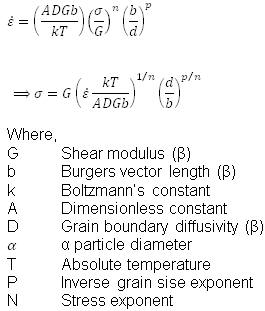 |
|
—|—
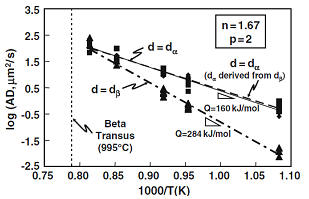
Fig.1. AD vs 1/T plot for Ti64.1
Table data (Type=16) - under development
FSTRES Material, Ftype(=16)
::
Not fully implemented Yet as of September 11, 2012
Flow stress function should be able to declare as 4-D…through GUI.
Flow stress as a function of strain, strain-rate, orientation index in Rodrigues space, temperature.
| OPERAND | DESCRIPTION | DEFAULT |
|---|---|---|
| Material | Material number | None |
| Ftype | Flow stress type = 16 |
REMARKS
Flow stress as a function of strain, strain-rate, orientation index in Rodrigues space, temperature.
User Routine (Type=N)
FSTRES Material, Ftype
DEFINITION
FSTRES specifies the flow stress for a particular material.
REMARKS
Flow stress data can be entered as one of 5 flow stress function types, or as a user subroutine. The FSTRES function for Ftype = -n is specified by the user in user subroutine n. The shell of the FORTRAN subroutine for defining flow stress is provided in the file DEF_USR.FOR located in the DEFORM system directory. For additional information about user flow stress subroutines refer to the “Installation” appendix.
RELATED TOPICS
Material Data: Flow stress Keywords: STRESS, STRAIN
Crystal plasticity model (Type=17)
FSTRES Material, Ftype(=17)
nHomogen, M, caHCP
ACTFL_1, ACTFL_2, …, ACTFL_M
DFTYP_1, DFTYP_2, …, DFTYP_M
nFuncTyp_LH, NT1
LH(1,1,1), LH(1,2,1), …, LH(1,M,1)
…
LH(M,1,1), LH(M,2,1), …, LH(M,M,1)
.
.
LH(1,1,NT1), LH(1,2,NT1), …, LH(1,M,NT1)
…
LH(M,1,NT1), LH(M,2,NT1), …, LH(M,M,NT1)
nFuncTyp_FR, NT2, NYF
T_FR(1), T_FR(2), …, T_FR(NT2)
FRP(1,1), FRP(2,1), …, FRP(NYF,1)
…
FRP(1,NT2), FRP(2,NT2), …, FRP(NYF,NT2)
nHRNo, nFuncTyp_HR, NT3, NYH
T_HR(1), T_HR(2), …, T_HR(NT3)
HRP(1,1,1), …, HRP(NYH,1,1)
…
HRP(1,M,1), …, HRP(NYH,M,1)
.
.
HRP(1,1, NT3), …, HRP(NYH,1, NT3)
…
HRP(1,M, NT3), …, HRP(NYH,M, NT3)
| OPERAND | DESCRIPTION | DEFAULT |
|---|---|---|
| nHomogen | Homogenization scheme (0-Taylor 1-VPSC) | 1 |
| M | The number of deformation modes | |
| (FCC: 1, BCC: 3, HCP: 3. Twinning mode is not implemented yet) | ||
| caHCP | The c/a ratio for HCP crystal | 1.0 |
| ACTFL_i | The activation flag for ith deformation mode | |
| (0: Not activated 1-Activated) | 1 | |
| DFTYP_i | The deformation type for ith deformation mode | |
| (0: Bidirectional slip 1-Single direction slip) | 0 | |
| nFuncTyp_LH | Latent hardening matrix function type | |
| (0: constants 1-f(Temp.)) | 0 | |
| NT1 | The number of temperatures for latent hardening function | 0 |
| T_LH(i) | The ith temperature for latent hardening function | 0 |
| LH(k,j,i) | The latent hardening coefficient contributed from jth deformation mode to kth deformation mode at the ith temperature | 1.0 |
| nFuncTyp_FR | Flow rule function type (0: constants 1-f(Temp.)) | 0 |
| NT2 | The number of temperatures for flow rule function | 0 |
| NYF | The number of parameters in flow rule | 2 |
| T_FR(i) | The ith temperature for flow rule function | 0 |
| FRP(j,i) | The jth parameter in the flow rule at the ith temperature | |
| nHRNo | The Hardening rule number | 1 |
| nFuncTyp_HR | Hardening rule function type (0: constants 1-f(Temp.)) | 0 |
| NT3 | The number of temperatures for hardening rule function | 0 |
| NYH | The number of parameters in hardening rule | 5 |
| T_HR(i) | The ith temperature for hardening rule function | 0 |
| HRP(k,j,i) | The kth parameter for jth deformation mode at the ith temperature in the hardening rule |
REMARKS
(1) Deformation modes and deformation systems The deformation systems are divided into different deformation modes. The number of deformation modes is M. | Crystal type | M | Deformation systems
—|—|—
FCC | 1 | 12 x {111}<110>
BCC | 3 | 12 x {110}<111>, 12 x {112}<111>, 24 x {123}<111>
HCP | 3 | 3 x {0001}<11-20>, 3 x {10-10}<11-20>, 6 x {10-11}<11-20>+12 x {10-11}<11-23>)
twinning deformation mode is not implemented yet.
Latent hardening matrix (M X M) is defined between the deformation modes.
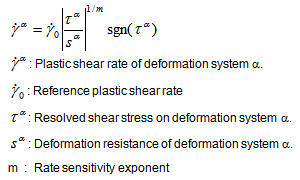
(2) The flow rule is described by
 |
|
—|—
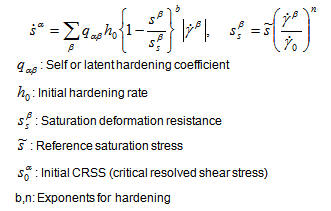
(3) Hardening rule 1 is described by
 |
|
—|—
(4) Hardening rule 2 is described by
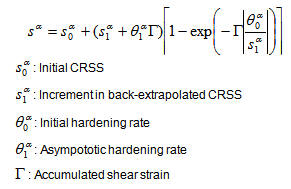 |
|
—|—
(5) The data formats for constant parameters
If NT1=0 (Constants for latent hardening matrix), the latent hardening matrix uses the following format:
0, 0
LHC(1,1), LHC(1,2), …, LHC(1,M)
…
LHC(M,1), LHC(M,2), …, LHC(M,M)
Where LHC(k,j) represents the latent hardening coefficient contributed from jth deformation mode to kth deformation mode
If NT2=0 (Constants for flow rule parameters), the flow rule uses the following format:
0, 0, NYF
FRPC(1), FRPC(2), …, FRPC(NYF)
where FRPC(j ) represents the jth parameter in the flow rule.
If NT3=0 (Constants for hardening rule parameters), the hardening rule uses following format:
nHRNo, 0, 0, NYH
HRPC(1,1), …, HRPC(NYH,1)
…
HRPC(1,M), …, HRPC(NYH,M)
where HRPC(k,j) represents the kth parameter for the jth deformation mode
EXAMPLES
Example 1: All parameters are constants FSTRES 2 17 1 3 1.0000000000E+000 1 1 1 0 0 0 0 0 1.0000000E+000 1.0000000E+000 1.0000000E+000 1.0000000E+000 1.0000000E+000 1.0000000E+000 1.0000000E+000 1.0000000E+000 1.0000000E+000 0 0 2 1.0000000E-003 1.0000000E-001 1 0 0 4 7.0000000E+001 1.0000000E+001 2.0000000E+002 1.0000000E+000 7.0000000E+001 1.0000000E+001 2.0000000E+002 1.0000000E+000 7.0000000E+001 1.0000000E+001 2.0000000E+002 1.0000000E+000
Example 2: All parameters are functions of temperature
FSTRES 3 17
1 3 1.0000000000E+000
1 1 1
0 0 0
1 2
9.0000000E+002 1.0000000E+003
1.0000000E+000 1.4000000E+000 1.5000000E+000
1.4200000E+000 1.0000000E+000 1.6000000E+000
1.5500000E+000 1.7000000E+000 1.0000000E+000
1.0000000E+000 1.0000000E+000 1.0000000E+000
1.0000000E+000 1.0000000E+000 1.0000000E+000
1.0000000E+000 1.0000000E+000 1.0000000E+000
1 2 2
9.0000000E+002 1.0000000E+003
1.0000000E-003 1.0000000E-001
1.5000000E-003 1.2500000E-001
1 1 2 4
8.5000000E+002 1.0500000E+003
1.5000000E+002 1.0000000E+001 4.4000000E+002 1.0000000E+000
1.5000000E+002 1.0000000E+001 4.4000000E+002 1.0000000E+000
4.5000000E+002 1.0000000E+001 4.4000000E+002 1.0000000E+000
1.0000000E+002 8.0000000E+000 3.3000000E+002 1.0000000E+000
1.0000000E+002 8.0000000E+000 3.3000000E+002 1.0000000E+000
3.0000000E+002 3.0000000E+000 3.3000000E+002 1.0000000E+000